Me and me lady like to eat. We like to eat and we like to travel. We like to eat, travel, and sometimes document the delicious things we eat, so we've made a few food videos for the internets. One of these videos has over 20,000 views. It must be really good, or really bad. Or somewhere in between. I guess it could be just an average video. Anyway, here are the first 3 episodes of The Hungry Backpacker. Hopefully we'll be making more in the near future.
Episode 1: Cuenca, Ecuador. Highlights include roast guinea pig and a burger the size of my face.
Episode 2: South Korea. Highlights include squirming, recently alive octopus tentacles and mouth watering KBBQ.
Episode 3: Legazpi, Philippines. Highlights include fertilized duck egg (balut) and fried chicken intenstines.
We've got a short trip to Kuala Lumpur coming up in April. If we're not too lazy, we might throw together a video then. After that we might try to do a video of our favorite spots back home in Oxnard, CA, USA.
It's now been about a month and a half
since we began our garden project in my dad's back yard here in
Borongan, Eastern Samar. So far, there have been a number of set
backs and frustrations, but quite a few things are going according to
plan.
One of the most frustrating things for me is a problem
that's really only specific to my particular plot of land here:
trash. Every time I want to start a new bed, I start digging, only
to find that for every cubic foot of soil, there's another cubic foot
of trash that I've got to dispose of first. I've filled up about 4
of those huge rice sacks full of trash in a single week. It's like
they've been using the lot as a landfill for several years now. I'm
not here to judge. If you send your trash to a landfill, you're just
throwing it in someone else's back yard anyway. And in fact, from
all the trash that does decompose, the soil does become a lot
richer. It's just a pain in the ass to have to sift through every
spadefull of dirt and separate the trash.
Creeper Xmas tree, featuring sitao, ampalaya, and sigadellas
Another set back has
been the climate, which brings us to this week's first lesson (one I
had known before getting started): stick with native crops and your
life will be much easier. Here in Eastern Samar, the weather seems
to vacillate between two extremes. It's either blazing hot under
the harsh equatorial sun, or it's a torrential downpour. There's not
a lot of in between. Most European crops don't like either of those
extremes, so growing them is possible, but it's a lot more difficult.
Unfortunately, I started with a bunch of packs of seed that I got at
hardware stores, and most of those are non-native varieties. So
that's what's up.
Most of the crops you'd think would fail
miserably in the tropics have done just that—cabbage, carrots,
cauliflower, onions. I got them to sprout, but they didn't last more
than a week or two, even protected from the sun and rain in the
nursery. Others seem to have mixed results. I've got sweet peas
that are doing ok, climbing up bamboo and more than a foot high, but
I've lost about half of them to the heavy rains before they got to
the climbing stage. My zucchini seemed to be doing great—it gets
broad leaves and a thick stem really quickly—but after
transplanting, they only lasted a week or two before being devoured
by these orange beetle looking things, and maybe picking up a
bacterial wilt. The onions I've tried to plant from the seed packs
are very difficult to keep alive, but I've planted quite a few of the
little mini onions available at the market here, and they seem to be
doing great.
Sweet peas
Meanwhile, the crops well-suited to the tropics
are unsurpsingly doing well. My star performer is a sitao plant
that's climbed higher than me already, and it's already starting to
produce some beans. If you haven't seen it, sitao is like green
beans, except each bean is like 2 or 3 feet long. The ampalaya
(bitter melon) is doing similarly well. I've got sweet corn and
white corn, and both are doing great with thick stalks and broad
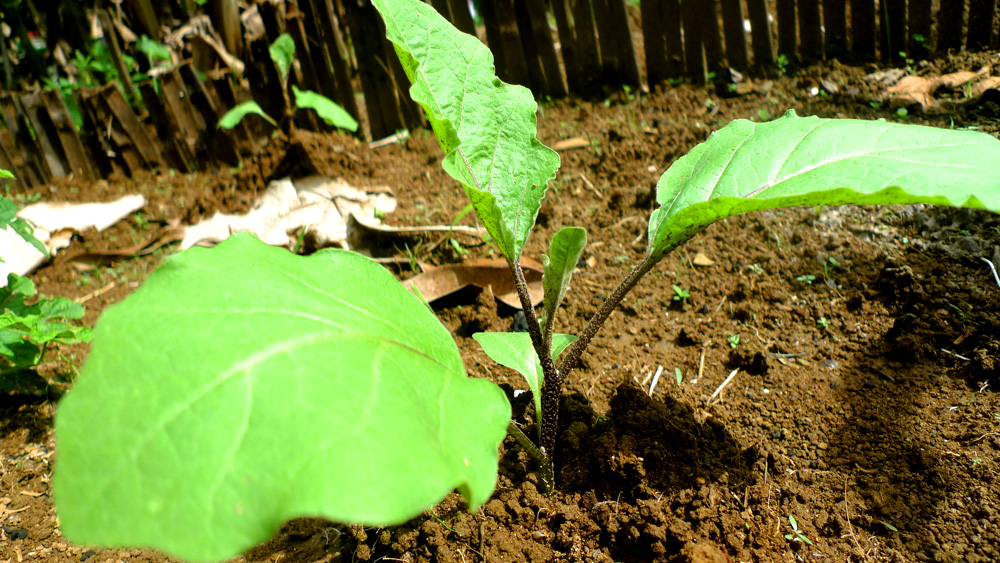
leaves. My eggplant and chilis seem to be doing fine. I only
planted a few kangkong plants, but it hasn't been troubled a bit by
the typhoon rains. And the cucumber plants seem to be doing great
too. They've got big broad leaves and they're producing flowers
already (I'm not sure if that detracts from their fruiting. .
.).
The worm bin is doing fine. I think there are more worms
now, because they go through waste a lot faster. There are also some
maggots in there now, but the bin is outside so they're not really
hurting anything, and I figure it just processes the waste quicker.
I'm starting to think I've been overthinking the compost thing,
though. The compost heap is also doing well. It's almost fully
decomposed only about five weeks later, I haven't really maintained
it much. The thing is, everything decomposes so fast here in the
tropics, I think it's a little unnecessary. I can just walk around
the yard and pick up the dead leaves, throw them into the beds, and
within a week or two they've decomposed and been absorbed into the
soil.
Peanuts going gangbusters. Tomato and cantelope on either side.
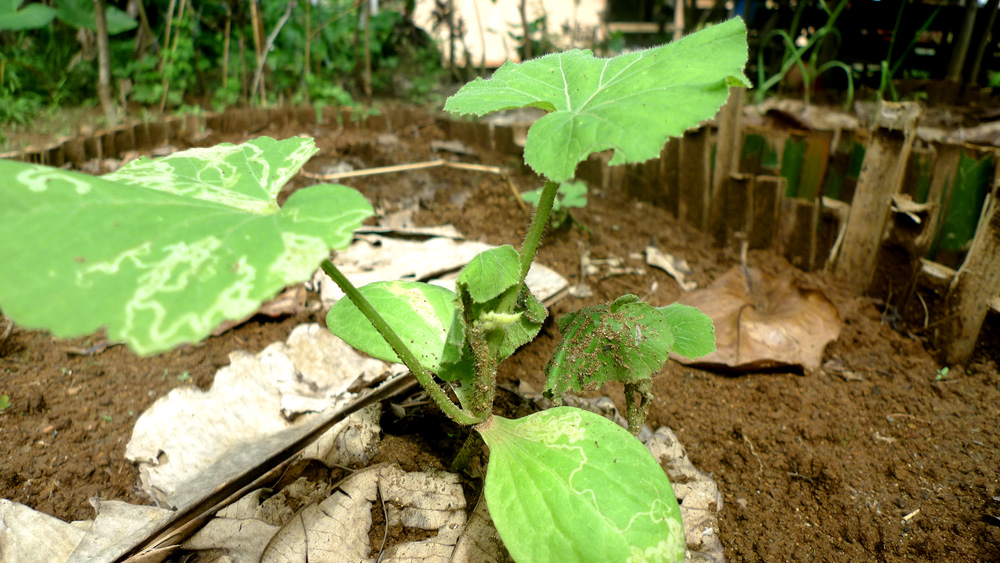
Those orange beetle things I mentioned are a real pain.
Researching on the internet, I haven't found what they are exactly,
but they seem similar to cucumber beetles in the plants they like to
eat and because some of the plants seem to develop a bacterial wilt
after being terrorized by them. They've destroyed my zucchinis,
nearly destroyed my watermelons, and they're big fans of the
canteloupe and pumpkin too. I've tried companion planting with onion
and garlic—seems to make no difference whatsoever. I've been
handpicking and squishing them, as it seems that might be the most
effective solution. We've got a few chickens running around here,
but I think they do more harm than good. I might look at setting up
a pond in the future to encourage frogs, but it would also encourage
mosquitos, and I've got plenty of them already.
Watermelon and some orange beetle terrorists
I've finished
another bed with bamboo stakes, and we threw down some gravel paths
so it's not such a mud bath when it rains. I'm keeping a constant
flow of new plants going in the nursery, so I'll continue to have new
stuff to transplant, and hopefully start harvesting some stuff in a
month or two. And Leia's adopted two gnarly, scroungy jungle puppies
that sleep outside our back door now. That's it for now.
Eggplant
Ladybugs humping on a chili plant.
Peanuts up close.
This tomato and a few friends survived my neglect during the typhoons.
It's been a while since my last update,
but there hasn't been much to report. Partly, that's because things
move a lot slower here—there's a lot of wait-and-see, and he'll ask
someone who'll ask someone else, et cetera, et cetera. But it's also
because the wifey and I took a week long break to meet up with some
friends in Boracay (which, by the way, was amazing). But we're back
now, and I'm back on the grind. Things are on track and a general
plan is starting to formulate.
Of the seeds that I planted in
pots, all of them sprouted and most of them seem to be doing well,
with the exception of the green onion. I'm not sure what it's
problem is. The sitao (green bean), ampalaya, corn, and cucumber did
so well that we were able to transplant them to various spots in the
garden, and they seem to be going strong, though the sitao has a bug
problem already. I also picked up some more seeds in Iloilo, on our
way back from Boracay, so we'll be planting those soon too,
hopefully. (There's watermelon, cantelope, mustard, white radish,
tomatoes, bell peppers, pumpkin, cabbage, carrots, sweet peas, and a
few more I can't remember). We've also got some peanuts from the
market, so I'm looking forward to using them as living
fertilizer.
The worm bin is doing well. I just put a little
spot of organic waste in there, and about a week later, the worms
have left me a nice, brown, slightly slimy pile of worm shit, perfect
for fertilizing soil. I've only made a small amount of fertilizer so
far, since I started with very few worms. But I've added more daily
(we've been moving a lot of dirt in the garden and I've found a
bunch), so I should be able to process more waste now.
The compost bin is also doing well,
though I think I need some more green stuff. I tried to cut the
materials down to little bits using garden shears, but that gets a
bit tedious, and most of the input was 4-foot-long dried carabao
grass, so a lot of it is in about 6-inch strips. Plus I added a
little bit of soil (it's mostly clay here), and I found a sack of
sawdust in a pile of garbage, so I threw some of that in too. And of
course, I'm adding all the kitchen waste that doesn't get fed to the
worms. It's doing well. It's hot to the touch on the inside, and at
the bottom there's already a nice layer of fertile soil. I'm turning
it once a week. I've got lots of room to add more stuff, but I'm
also kind of lazy, so we'll see what happens.
We've cleared a good spot of land, but
after doing so, it became clear that in the big open plot there's a
big problem—the sun. See, the Philippine sun don't f*** around.
In just a few hours in can lay waste to the hardiest carbon-based
life forms, be they animal or vegetable. Thus, only a few of the
plants we've got will actually thrive in those conditions. The rest
will wither. So I've got a few solutions lined up. Long term
solution: plant more trees. We've already got some coconut and
banana saplings around the lot that could be moved, plus I plan to
buy some other saplings as soon as this mysterious tree truck
everyone tells me about makes an appearance. Medium term solution:
plant a ton of corn, which will provide shade to nearby plants as it
gets bigger. Immediate solution: choose better areas to plant.
Which leads me to my next point.
I f***ing love bananas. I'm
bananas. For bananas. And not just because they're delicious.
Banana trees are godsends for tropical organic farmers. They grow in
clusters, since new banana trees are formed from the 4 little shoots
that pop out the bottom of mature trees. They've got huge leaves,
and even on healthy trees, half of the leaves are usually dead and
wilted. They fall off and decay, and the trees feed on that added
nitrogen in the soil. Banana trees are mostly water, so when they
die, the trunks decay super fast, too. What that means is this: if
you've got a little circle of banana trees, you plant some raised
beds around its base. The banana leaves provide dappled shade,
protecting vulnerable young plants from the harsh sun. As the leaves
fall off, or after you harvest bananas and chop down the trees, you
can throw all of the organic waste in the center of the cluster,
where it will decay. When it rains, you've got a natural fertilizer
dispenser, adding nitrogen to your beds. At least, that's the theory
I'm going with. We'll see how it works out.
We're using
bamboo stakes to make the raised beds. Bamboo is cheap and
plentiful, and works great to form pretty curves. Also, I use
these big elephant ear leaves for spot mulching around young plants.
It helps keep moisture in the soil and also discourages weeds from
getting too close.
That's about it for now. There's a lot
more work to do and a lot more things to plant, but I have direction
now, and I'm excited about how everything is going to turn out.
My wife and I are currently in Borongan, Eastern Samar, Philippines. We're staying in my dad's house, which was otherwise being unused. We'll be here for the foreseeable future, and my primary goal during our stay is to turn the unused lot behind the house into a small organic farm/large organic garden. I'm going to be posting updates on here to track my own progress and also to contribute to the vast online permaculture community.
I should note that I have no idea what I'm doing. Aside from being forced to slave away in my mother's vegetable garden as a child, I have no experience growing anything, so organic tropical permaculture is new to me. But I'm a firm believer that you can become an expert on anything with the help of the internet. Plus, I have tons of local knowledge to help me out (though it might take a bit to get the permaculture idea across here, since the typical practice is slash-and-burn, plow up large plots, and plant monoculture crops). I expect a lot of trial and error. A lot of error. But I'm going to learn a ton in the process, and hopefully end up with some yummy fruit and veg for my kitchen table.
Here are some 'before' pictures:
There are already some banana tree clusters, a few coconut trees, and some other fruit trees spread randomly across the lot.
The first step is to cut the 4-foot tall Jurassic Park grass. A machete is way more labor intensive, but less hassle, since the weed eater constantly bogs down in the heavy, damp grass. I'm sure plenty of permaculturists will cry foul at the burning, but in my defense, they started burning before I got there. From things I've read, it seems that the primary problem with burning is the loss of all that organic matter which could return nutrients to the soil. But tropical weeds don't f*** around, and they gots to go. Plus, I've still got tons of Jurassic Park grass on the lot, and I'm going to turn it into compost.
Planted some test run seeds in pots a few days ago. Most of them have sprouted and broke surface already. Not all of them can be transplanted, but I was bored and wanted to start somewhere, so I planted them. I've got ampalaya, sweet corn, cucumber, chili pepper, pechay (like bok choi), kangkong, sitao (green beans), and green onion.
Leia is stoked that the house has an oven, and she's getting a puppy too.
I made a worm bin, so I can feed them our fruit and veg scraps and they can give me worm poop to use as fertilizer. Just started it yesterday, but the worms seem lively and happy, so I'll start adding food in about a week.
That's the first update. Next up in the project is finish cutting the grass, till the soil as necessary, start a mandala garden with raised beds, build a compost bin and start composting, and go from there.
After a month of picturesque
tropical beaches, impromptu dance parties in volcanic craters, and enough rice and beans con chuleta to feed a
village for a year, it was time to go on a honeymoon. After such a magical time in Costa Rica, we
certainly deserved the horrible flight we had.
We spent an entire day in the airport in Bogotá—we reasoned that 10
hours in the city wasn’t worth $40 each in exit fees, not to mention stamps
taking up valuable space in our passports—but eventually we touched down in the
middle of the world, Quito, Ecuador.
Since we arrived late at night,
we took a taxi straight to our hotel in the Old City and went to sleep. The center of Quito is divided into two
parts—the Old City is a Unesco World Heritage Site, home to the lion’s share of
the city’s colonial architecture; the bulk of accommodations and restaurants
are in the New City, a more modern area with skyscrapers and whatnot. We would be in Quito for only a few days, so
we chose to stay in the old city. It was
difficult to get a feel for the city at night, through the window of a speeding
taxi, so we really didn’t know what to expect, but this is what we woke up to:
Quito is a magnificent city, and
it’s not surprising that it was the first city to be declared a World Heritage
Site. It is said that of the various
South American cities established under Spanish colonialism, Quito is the best
preserved, and the mark left by the imperialist Spaniards is unmistakable. Indeed, the city looks and feels in many ways
like Madrid and other Spanish cities.
The cobblestone streets are narrow and the elegant brick buildings tall,
providing much-needed respite from the harsh Andean (and equatorial) sun, which
at this altitude must be only a few miles away.
The public squares, too, reminded me of my time in Spain—broad plazas
flanked by cathedrals, monasteries, and churches with chic little cafes, where
tourists sit people watching (and pigeon watching) and sipping on coffee.
But Ecuador is not Spain, and
it’s distinctly Andean flavor becomes evident when you see the indigenous women
in traditional dress. Dark skin under
colorful skirts and shawls, their short frames topped with the fedora and
bowler-type hats traditional in the region.
Old women who, in their prime, couldn’t have been more than five feet
tall, hunched over to half their height, shuffling slowly under loads twice
their weight. And old men, selling teas
made from coca leaves (though I was disappointed not to encounter the leaves
themselves).
Quito is a huge city the sprawls for miles, but the old city itself is well
defined, hemmed in on most sides by mountains, so you can tell you’re getting
out of the center if you start climbing.
There are various statues and monuments perched on hills overlooking the
city, but we had read that it was dangerous to hike around these areas, as
robberies and assaults are common.
Nevertheless, we saw a statue of an angel up on a hill which was certain
to offer a spectacular view of the city.
It seemed only a short hike (20 minutes tops), so we decided to head
towards it, and to turn back if at any point it seemed unsafe.
Sure enough, as we ascended the streets away from the center, the crowds
dissipated more and more, until only the occasional shopkeeper or restaurant
could be seen. At one point, we were
being followed by a sketchy looking middle-aged man with a bulky jacket, though
it was warm out. I kept tabs on him,
glancing around nonchalantly. He
followed us, about 20 or 30 meters behind, for several blocks. Finally, we stopped on a corner in front of
an open shop and I turned around completely, staring him full in the face. He immediately looked away and crossed the
street, passed an intersection, ducked into an alley and disappeared.
We decided not to stray any further from civilization, but in the next block we
found ourselves at the foot of the steps leading to the angel. We approached them to take a look. A few steps up sat two old men talking to one
another. “Good morning,” I offered in
Spanish. The men stared at us with blank
looks on their faces. “Are these the
stairs that lead to the statue?” I was
just trying to make conversation. They stared
some more. After an awkward silence of
thirty seconds, one of them began to shake his head slowly. He pulled his thumb across his neck in an
ominous gesture. More staring. “Aqui te roban,” he said at last, pointing to
the bulge in my hoodie where my camera was so cleverly hidden. “Aqui te matan.” Here,
they rob you. Here, they kill you. He made the gesture again, then turned and
pointed behind him. On the white cement
wall was stenciled in Spanish “Zone of Robberies—Do Not Enter.” Well,
that’s clear enough, I thought. How nice of them to reserve an area of the
city exclusively for muggers. We
headed back down toward the center.
We spent only one full day in
Quito, since we were eager to get to Cuenca and find teaching jobs before the
semester got too far underway. But in
our brief stay, we saw loads of beautiful old Catholic buildings, statues of
dead heroes, and bustling markets with deliciously cheap food. We didn’t do our homework, so we know nothing
of the history of the various landmarks we visited, or even what they were
called. We just ambled around like
ignorant tourists going, “that looks cool, let’s take a picture.” Here are the results:
We decided to break up the
10-hour journey to Cuenca with a stop about halfway in the small city of Baños. Baños is one of the most visited cities in
Ecuador, by foreigners and Ecuadorians alike.
The main attractions are a series of volcanically heated, mineral rich,
thermal baths. For around two dollars,
you can relax and swim in several different
pools of varying temperatures, from pleasantly lukewarm to scalding hot. The water is a murky, sulfurish yellow color
and smells something like cucumber mud, and it’s rumored to cure all kinds of
ailments, from skin diseases to cancer.
Of course, it’s a little unsettling to think that you may be sharing a
pool with a gaggle of infected, afflicted old people, but that’s why we don’t
think about those things. We went at the
crack of dawn to beat the gringo hordes.
At that time it’s chilly outside, and it’s inspiring to sit back and
watch steam rise from the hot yellow water, while in the background you see a
waterfall gently cascading down a cliff.
Oh yeah, the waterfalls. Baños is also known for its waterfalls. A few of them flank the city and fall from
the surrounding hillsides. Many more can
be seen along the road that leads downhill out of town, falling several
thousand feet over about 80km before arriving in the Oriente, at the edge of the Amazon jungle. Baños is also an adventure capital, so you
can travel this route on all kinds of wheeled contraptions—mountain bikes, dune
buggies, four-wheelers, motorcycles and more.
We rented a rickety old quad with absolutely no suspension and had a
blast.
Hiking is another popular
activity in Baños. The elevation (it’s
much lower than Quito) makes for a subtropical climate—warm enough for T-shirts
without getting overwhelmingly hot or muggy, as it can on the coast or in the
jungle—so it’s perfect for walking around and enjoying nature, and ascending
the various trails that lead out of the town and up the hillsides provides for
spectacular views of the town, nestled comfortably in the river valley.
Leia and I discussed how perfect
Baños would be to live in, both for its climate and its size. We contemplated looking for jobs there, but
it’s too small of a city to have many opportunities for English teachers, and
Leia already had an interview scheduled in Cuenca, so after a few short days in
Baños, it was on to the next adventure.
It seems to me that the fundamental difference between tourists and travelers who aren’t tourists is that tourists stay, or at least try to stay, within their respective comfort zones. Non-tourists, on the other hand, seek out adventure in the form of spontanaeity and uncertainty. Of course, nothing is absolute and there’s a little bit (or a lot) of tourist in all of us, but I’ve noticed that the more you travel outside of your comfort zone, the wider that comfort zone becomes, so that I’ll often see or do things now and take no notice at all—things that just a couple years ago would have been unthinkable.
I moved to California when I was seventeen, and it took me a good three years to work up the courage to try menudo, which is just a Mexican soup made with beef tripe. Menudo, I guess, was my “gateway food,” and from there it was inevitable that I’d move on to harder stuff, like cow tongue, or pickled pig’s feet. When I started leaving the country, however, things started to get really interesting.
In the Philippines, I fell in love with sisig—sizzling pork face. Yes, pork face. They chop it up, serve it to you on a hot skillet and break an egg over it, and lord is it delicious. I also became a big fan of isaw ng manuk, or chicken intenstine kabobs. It may not look appealing on the stick, but I’ve found that I get a lot more out of life if I let my tongue make those judgments. And no culinary adventure to the Philippines is complete without sampling balut, the infamous fertilized duck egg. Balut has gotten a bad rap, I feel, but the experience really varies depending on what kind you try. They’re sold based on how long the egg is allowed to incubate, so the 15 day is like a rich, earthy, hard-boiled egg, and the 21 day—well, you’re eating an aborted duckling, often with down and cartilagey beak intact. Not for the vegetarian or faint of heart, certainly, but if you eat it while you’re drinking beer (as most do), it goes down smooth and tasty.
In Thailand, my linguistic shortcomings meant that I was often ordering things without knowing what animal they came from, much less what part of the animal. But it was all Thai food, so it was all delicious. The only exception was on the backpacker strip of Khao San, when I sampled a variety of creepy crawlies. Among them were—and keep in mind I’m no [whatever bug scientists are called]—crickets, grasshoppers, meal worms, and even a cockroach. The only one I could recommend in good conscience is the meal worm, and really it has no taste at all, but the texture is mildly pleasant. You might be thinking, “what an idiot! Why would you eat bugs? I could’ve told you they’re not good and I’ve never tried them.” Sound logic, I’ll admit, but I can tell you they’re not good and I have tried them. Who has more expertise on the matter?
I’ve continued to nurture my gastronomic curiosity here in the Pacific. There were other volunteers in my group who wouldn’t eat fish because, after their host families fried it, it was still a fish—head, tail, fins and all. [Now I know that in the U.S. we’re fond of eating our food without knowing where it comes from (if not, there would be many more vegetarians), but a fish? Hell, you can pluck a fish right out of the stream and bite right into its belly. I saw Survivorman do it once. If you’re not yet at that stage, don’t worry; you and your comfort zone just have a little growing to do.]
I have to admit, the hardest part about strange food is knowing what the strange food is. That’s why canned mystery meat is such a hit—there’s no paper trail. Even if you wanted to you couldn’t find out what’s in it, so you just don’t question the source, and life is better that way. Thus, when I came home from training one day in Pohnpei and saw the charred carcass of a snub-nosed, four-legged beast, my brain (trying to protect me, I assume) thought ‘My, if that isn’t the strangest looking pig I’ve ever seen.’
“Sure I’ll try some,” I said, “Give me a piece off the hock there, where it’s real meaty.” Indeed, it tasted just like pork, or rather, the texture was just like pork but its taste was bland. My host father asked me if I liked it. “Yes, very delicious,” I lied in Pohnpeian.
“Yeah, the reason we killed that dog,” he explains, “is cuz he was killing all the chickens.” I like to think of myself as stout and unshakable, like a lumberjack, but for a brief moment, I questioned my resolve and wondered if I’d be able to keep it down. I did keep it down, and having done so it’s hard for me to imagine another food that would give me pause, short of human flesh (though I’m not above it).
Since I’ve been in Palau, I’ve added a few more tasty treats to my list. Stingray tastes just like fish, with the nice benefit that all the bones are sandwiched between two layers of white meat, making it easy eating. Shark is similar, but the taste is better, especially barbecued. I'm told that the smaller sharks are the best, and as an added bonus, they don't take up all of your freezer space.
Pigeon, or at least the pigeon-like bird that I ate, is rich, dark meat and tastes similar to duck. Fruit bat looks hellish and uninviting on the plate, what with the fur and vicious incisors and all, but it tastes like poultry—not quite like chicken, but close. And if you can get past your feelings of remorse, sea turtle is delicious when prepared well in a stew. The meat itself is pinkish and has the taste and consistency of ham, but there are all sorts of bits on a sea turtle, some of them fatty, some chewy, and they all go in the pot. Crocodiles are a protected species here, but I’m not a hundred percent sure I’d turn down an offer to make one my lunch.
This is what I mean when I talk about the dangers of expanding your comfort zone. You might wake up one day and find yourself eating cockroaches just for the hell of it. So if you’re not okay with that, you know what to do. When your Mexican friends ask “have you ever tried menudo?” Just say no.